
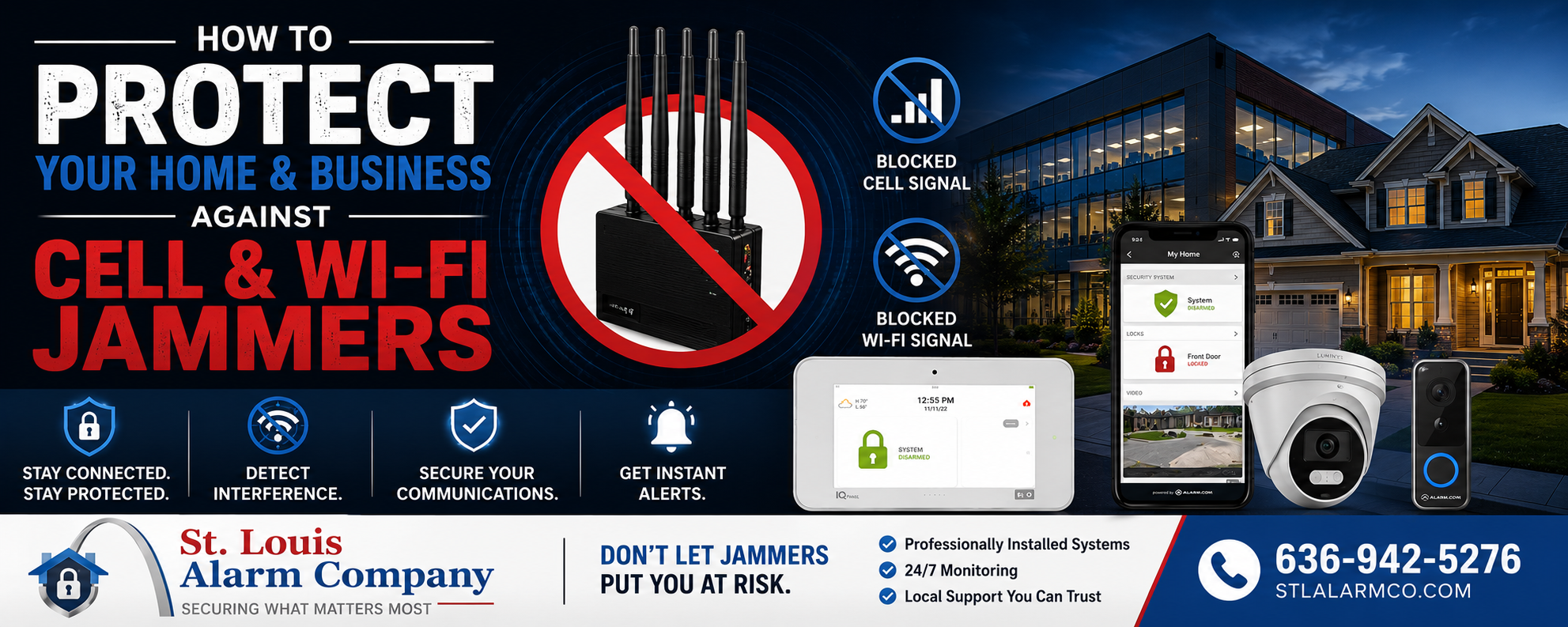
Criminals are becoming more sophisticated—and so should your security system.
Over the last few years, law enforcement agencies across the country have reported criminals using cellular and Wi-Fi jammers in an attempt to disable wireless security cameras and alarm systems before breaking into homes and businesses. While these devices remain illegal in the United States, they have become easier to obtain through overseas marketplaces, making them a growing concern for property owners.
At St. Louis Alarm Company, we design security systems that don’t rely on a single point of failure. If you’re protecting your family, business, or investment property, understanding how signal jammers work can help you choose the right security solution.
What Is a Cell or Wi-Fi Jammer?
A signal jammer is an electronic device that intentionally broadcasts radio interference to block wireless communications.
Depending on the type of jammer, it can interfere with:
- Cellular alarm communicators
- Wi-Fi security cameras
- Wireless networks
- Bluetooth devices
- GPS signals
A burglar’s goal is simple:
- Prevent alarm signals from reaching the monitoring center
- Stop Wi-Fi cameras from uploading video
- Delay notification to the property owner
- Create enough confusion to gain entry before anyone notices
Fortunately, modern professionally installed security systems include multiple layers of protection that greatly reduce this risk.
Are Cell and Wi-Fi Jammers Legal?
No.
The Federal Communications Commission (FCC) prohibits the use, sale, or marketing of signal jammers because they interfere with authorized radio communications—including emergency services. Anyone operating one is violating federal law.
Warning Signs You May Be Experiencing Signal Jamming
Although internet outages and poor cellular coverage happen naturally, multiple symptoms occurring at once may indicate intentional interference.
Possible Wi-Fi Jamming
- Security cameras suddenly go offline
- Smart home devices disconnect simultaneously
- Wi-Fi network disappears unexpectedly
- Strong internet connection suddenly becomes unusable
- Wired devices continue working while wireless devices fail
Possible Cellular Jamming
- Multiple phones lose service at once
- Alarm panel loses cellular communication
- No calls or text messages can be sent
- Signal bars rapidly fluctuate
- Service returns after leaving the immediate area
These symptoms do not automatically mean a jammer is present, but they should be investigated—especially if they coincide with suspicious activity around your property.
How to Protect Yourself Against Signal Jammers
The best defense is layered security rather than relying on one communication method.
- Use Professional Alarm Monitoring
A professionally monitored security system watches your property 24/7.
If communication with the alarm panel is lost unexpectedly, many modern systems generate a communication failure or supervisory event that can alert the monitoring center depending on system configuration and the duration of the outage. This provides an additional layer of awareness beyond a standard burglary alarm.
- Hardwire Critical Equipment
Whenever possible:
- Install PoE (Power over Ethernet) security cameras
- Hardwire alarm panels to the internet
- Use wired door contacts for commercial properties
- Reduce dependence on Wi-Fi for critical security devices
Hardwired equipment cannot be disabled simply by jamming Wi-Fi signals.
- Choose Cameras with Local Recording
Many inexpensive Wi-Fi cameras only store footage in the cloud.
If internet communication is interrupted, recording may stop.
Professional surveillance systems from St. Louis Alarm Company use Network Video Recorders (NVRs) that continue recording locally even if the internet is unavailable.
This means valuable evidence is preserved even during communication outages.
- Install AI Video Analytics
Modern AI cameras detect:
- People
- Vehicles
- Intrusion zones
- Loitering
- Line crossing
Instead of waiting for a burglar to reach your building, intelligent analytics can alert you as suspicious activity begins.
- Add Exterior Deterrence
Visible security discourages criminals before they ever attempt entry.
Recommended deterrents include:
- Motion lighting
- Warning signs
- Visible surveillance cameras
- Video doorbells
- Audible sirens
- Security monitoring decals
Most burglars prefer easier targets.
- Use Multiple Communication Paths
Modern alarm systems can be configured with multiple communication methods, such as broadband internet and cellular backup. If one path becomes unavailable because of an outage or interference, the system may still be able to communicate over another path, improving overall resilience. No communication method is immune to every type of interference, so layered redundancy is important.
- Upgrade Older Security Systems
Many older security systems:
- Lack communication supervision
- Use outdated wireless technology
- Do not support encrypted devices
- Cannot detect RF interference
- Offer limited notification capabilities
Today’s professionally installed systems provide far greater awareness and resilience than systems installed 10–20 years ago.
Why Professional Security Matters
DIY security products often rely entirely on:
- Home Wi-Fi
- Consumer cloud services
- Battery-powered wireless cameras
Professional systems provide:
- Local recording
- 24/7 monitoring
- AI detection
- Commercial-grade equipment
- Redundant communication options
- Professional installation
- Ongoing service and support
A properly designed security system isn’t just about recording a crime—it’s about reducing the chance of one happening in the first place.
How St. Louis Alarm Company Protects Against Modern Threats
At St. Louis Alarm Company, we build security systems with multiple layers of protection.
Our solutions include:
- Professionally monitored alarm systems
- Hardwired and wireless security solutions
- NDAA-compliant commercial surveillance systems
- AI-powered analytics
- Local NVR recording
- Smart home integration
- Commercial access control
- Video verification
- 24/7 U.S.-based monitoring
Whether you’re protecting a home, retail store, warehouse, office, apartment complex, or investment property, we’ll design a system tailored to your needs.
Schedule Your Free Security Assessment
Don’t wait until after a break-in to discover your security system’s weaknesses.
If you’re concerned about Wi-Fi jammers, cellular interference, or outdated equipment, St. Louis Alarm Company can evaluate your current system and recommend the best upgrades to keep your property protected.
Call St. Louis Alarm Company today at 636-942-5276 to schedule a free consultation.
Serving St. Louis, St. Charles, St. Peters, O’Fallon, Wentzville, Chesterfield, and surrounding Missouri communities with trusted residential and commercial security solutions.